Article: Dollaro vs. Full-Grain Leather: What's the Difference?
Dollaro vs. Full-Grain Leather: What's the Difference?
By: Adoratti
The Leather Question Most Handbag Buyers Get Wrong
Here is a common assumption worth challenging: pebbled leather is lower quality than smooth leather. It sounds logical, but it is not always true. In fact, one of the most sought-after Italian leathers in the world is pebbled by design.
If you have ever felt overwhelmed by terms like "genuine leather," "top-grain," and "full-grain," you are not alone. These labels are thrown around loosely, and they rarely tell you what you actually need to know before spending your money.
This article offers a clear, honest side-by-side comparison of Dollaro leather and full-grain leather so you can make a truly informed decision. With the global handbag market valued at $56.48 billion in 2024 according to Grand View Research, and leather dominating as the top material segment, understanding what you are buying has never mattered more.
What Is Full-Grain Leather? The Gold Standard Explained
Full-grain leather comes from the outermost layer of the animal hide. It has not been sanded, buffed, or corrected in any way. This means the densest, strongest natural fibers remain completely intact, along with the original grain pattern of the hide.
This is why full-grain leather is universally considered the highest quality grade of leather. No surface correction means nothing has been removed or hidden. What you see is the real thing.
One of the most celebrated qualities of full-grain leather is its patina. Over time, scratches, oils from your hands, and everyday exposure create a rich, evolving surface that adds character rather than detracting from it. Leather enthusiasts consider this aging process a hallmark of authenticity and craftsmanship.
It is worth noting that full-grain leather can be processed through different tanning methods. Chrome tanning accounts for roughly 90% of global leather production, while vegetable tanning makes up only about 10%. Both methods can produce full-grain leather, but the tanning process significantly affects the leather's feel, aging behavior, and environmental profile.
For handbag construction, full-grain leather typically ranges from 1.6mm to 2.5mm in thickness. Premium bags will feature 6 to 8 stitches per inch to ensure structural strength without weakening the hide. Well-maintained full-grain leather goods can also retain 40 to 60% of their original retail price on the resale market.
What Is Dollaro Leather? Italy's Embossed Full-Grain
Dollaro leather is produced by Conceria Walpier, a renowned tannery based in Tuscany, Italy. Walpier has built a global reputation for premium vegetable-tanned leathers, and Dollaro is one of their most distinctive offerings.
The process begins with Buttero leather, a premium vegetable-tanned full-grain cowhide. This base hide is then heat-embossed with a large pebble grain pattern, giving Dollaro its signature textured surface.
Here is the critical point that many people miss: Dollaro is a type of full-grain leather, not a downgrade from it. The embossing is applied on top of a full-grain base. The hide's strongest fibers and natural structure remain fully intact beneath that pebbled surface.
Dollaro's physical specifications reflect its premium positioning. It measures 2.0 to 2.2mm in thickness (5.0 to 5.5 oz) with a firm temper that adds natural structure to handbags, reducing the need for excessive internal reinforcement.
The heat-embossing process also corrects minor surface defects that would normally be visible on the base Buttero hide, resulting in a more consistent appearance across the leather. On lighter colors, the tops of the pebbles darken slightly during embossing, creating a subtle two-tone effect that adds visual depth and dimension.
Italy and the UK together account for over 35% of European artisan leather handbag exports, and tanneries like Conceria Walpier are a major reason why Italian leather carries the reputation it does worldwide.
Dollaro vs. Full-Grain: A Direct Side-by-Side Comparison
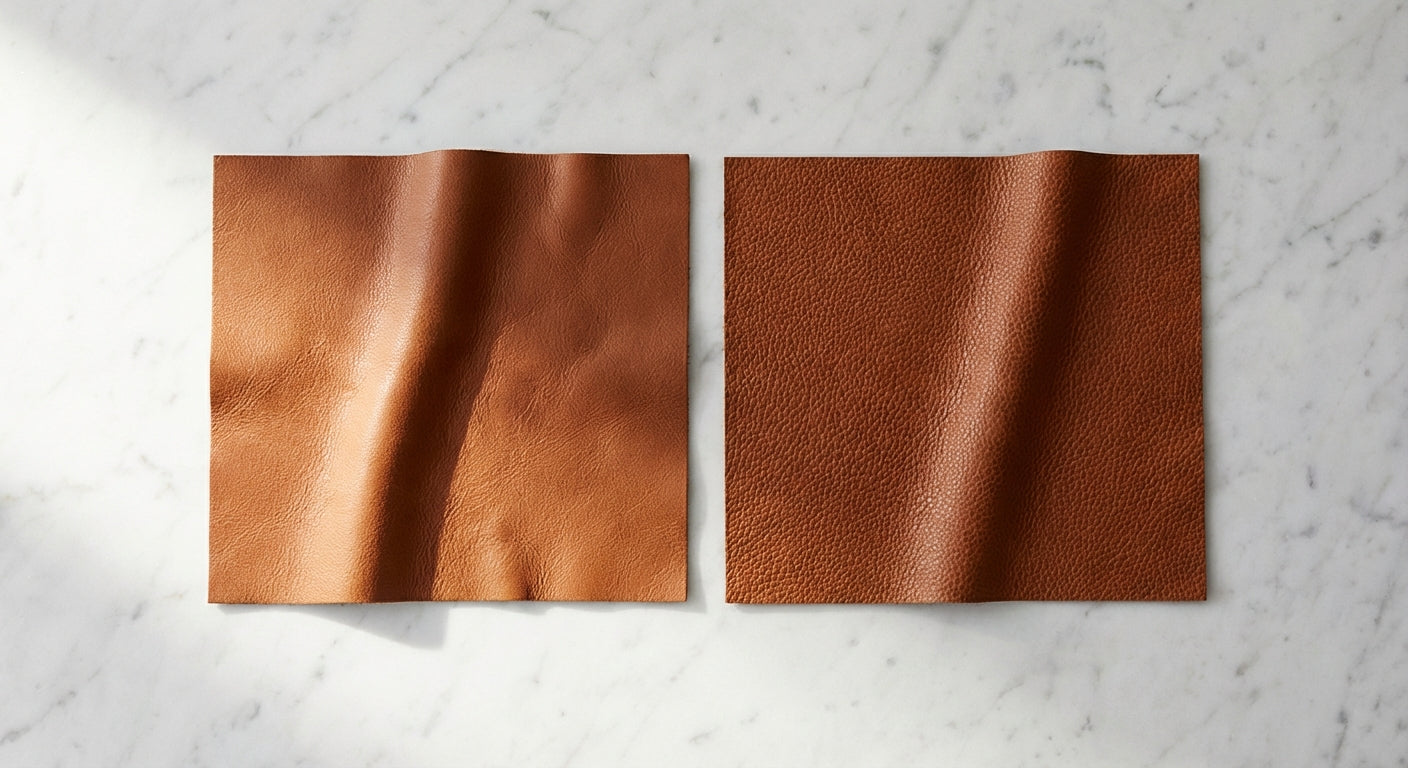
Since Dollaro is technically a full-grain leather, the real comparison here is between embossed full-grain (Dollaro) and smooth, unembossed full-grain leather. Here is how they stack up across five key dimensions.
Surface Texture
Smooth full-grain leather retains the completely natural hide surface, including any natural markings, insect bites, or variations. Dollaro features a heat-embossed pebble pattern that is applied artificially but sits on top of a genuine full-grain base. The texture is deliberate and consistent.
Tanning Method
Dollaro is exclusively vegetable-tanned, placing it in the roughly 10% of global leather production that uses this traditional method. Plain full-grain leather can be either vegetable-tanned or chrome-tanned. This is a key distinction for sustainability-minded buyers, though it is worth noting that a study cited by Collective Fashion Justice found "no significant differences" between the environmental footprints of the two tanning processes.
Patina Development
Smooth full-grain leather develops a dramatic, character-rich patina relatively quickly. Every scratch and mark becomes part of the story. Dollaro develops patina too, but more slowly and more uniformly. The embossing does not fade over time, so the textured surface remains consistent even as the leather ages.
Scratch Resistance
This is where Dollaro has a clear practical advantage. The pebbled surface is significantly more resistant to visible scratches compared to smooth full-grain leather, making it a strong choice for a handbag that sees daily use.
Visual Consistency
Heat-embossing masks minor natural hide variations, giving Dollaro a more uniform appearance across the entire piece. Smooth full-grain leather, by contrast, shows natural markings that purists value as authenticity signals. Neither is objectively better; it comes down to personal preference.
Which Leather Is Right for Your Handbag?
This is not a question of quality hierarchy. Both Dollaro and smooth full-grain leather are premium materials. The right choice depends on your lifestyle and what you want from your bag.
Choose smooth full-grain leather if: you love the idea of dramatic patina aging, you appreciate natural hide markings as proof of authenticity, and you lean toward a classic, understated aesthetic aligned with the "quiet luxury" movement.
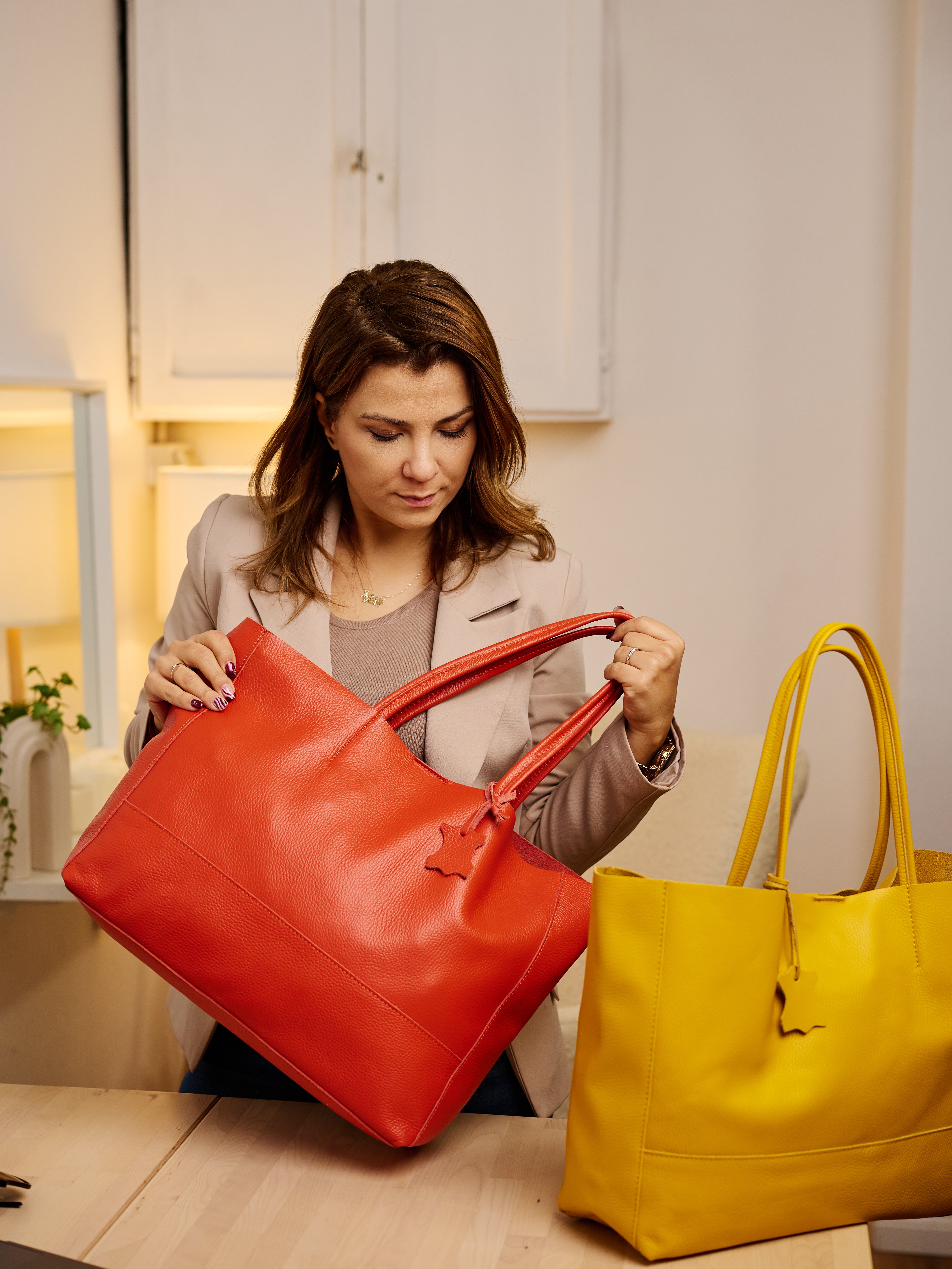
Choose Dollaro leather if: you want everyday practicality with enhanced scratch resistance, you prefer a structured handbag silhouette (Dollaro's firm temper delivers this naturally), and you are drawn to the distinctive textured look with that subtle two-tone depth effect.
From a financial perspective, both are smart long-term investments compared to fast-fashion alternatives. Well-maintained pieces in either leather can retain 40 to 60% of their original retail price on the resale market. Think of it as a cost-per-wear calculation: a bag you carry for years costs far less per use than one that falls apart in months.
On the sustainability front, Dollaro's exclusive vegetable-tanning process and traceable Italian origin through Conceria Walpier in Tuscany align with growing demand for eco-conscious luxury. That said, the environmental picture is nuanced; research has found no significant difference between the environmental footprints of vegetable and chrome tanning processes. Honest transparency matters more than marketing claims.
As for care, both leathers benefit from regular conditioning. Dollaro's semi-gloss finish and pebbled surface have slightly different conditioning needs than smooth full-grain, but neither is high-maintenance. A quality leather conditioner applied every few months will keep both looking their best for years.
The Bottom Line: Leather Knowledge Is Your Best Buying Tool
If you take one thing away from this article, let it be this: Dollaro is not a lesser alternative to full-grain leather. It is a specialized, embossed full-grain leather with its own distinct set of advantages.
The three most important distinctions to remember are: embossed versus natural surface, patina speed and character, and scratch resistance for everyday use. These are practical differences, not quality differences.
Look beyond brand names and marketing buzzwords. Understanding leather grades, tanning methods, and construction details is the real mark of an informed buyer. It protects your investment and ensures you get exactly what you are paying for.
Whether you choose smooth full-grain or Dollaro, both represent the top tier of leather quality and will reward you with years of use. Now that you know the difference, we invite you to explore our handbag collection with fresh eyes and the confidence to choose what is truly right for you.
Sources
- Grand View Research – Global Handbag Market
- Rustic Town – Which Leather is More Durable and Best for Bags?
- Collective Fashion Justice – Is Vegetable Tanned Leather Sustainable?
- Szone Ier Leather – 18 Best Full Grain Leather Bag Brands Guide
- San Rocco Italia – Leather Grades: Why Quality Matters for Luxury Bags
- Coastal Leather Supply – Dollaro by Conceria Walpier
- Leather Skins – Conceria Walpier Dollaro Leather